Your Complete Guide for Used EV Shoppers in Matteson, IL
Buying a used electric vehicle is one of the smartest ways to enjoy the benefits of EV ownership while saving thousands compared to buying new. But unlike a traditional gas-powered vehicle, the single most important component to evaluate on a used EV is the high-voltage battery. If you’re trading in your current vehicle, learn more about our trade-in process before shopping for your next EV.
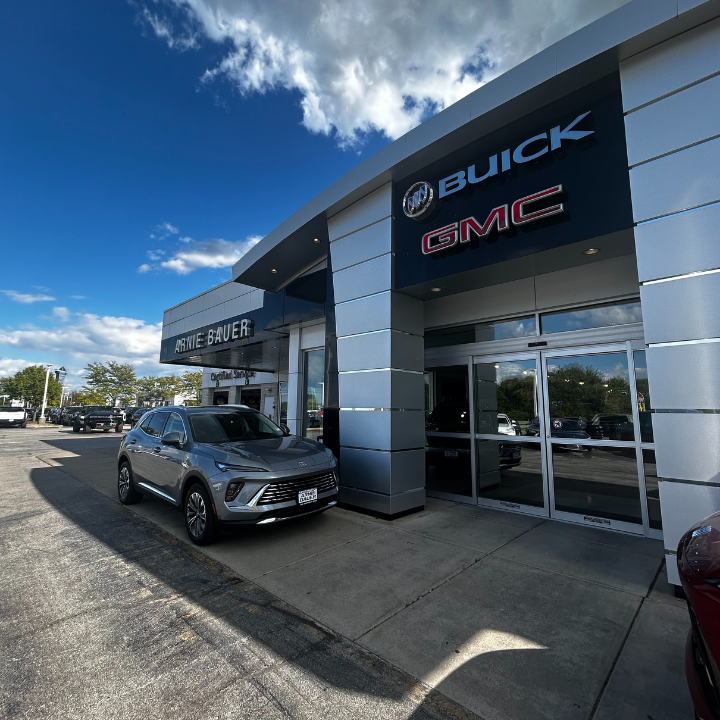
At Arnie Bauer Buick GMC in Matteson, IL, we help drivers throughout Matteson, Tinley Park, Frankfort, Olympia Fields, Homewood, Richton Park, and Chicago’s South Suburbs find high-quality used electric vehicles with total confidence. Here’s everything you need to know about evaluating EV battery health before making your purchase.
Why Battery Health Matters
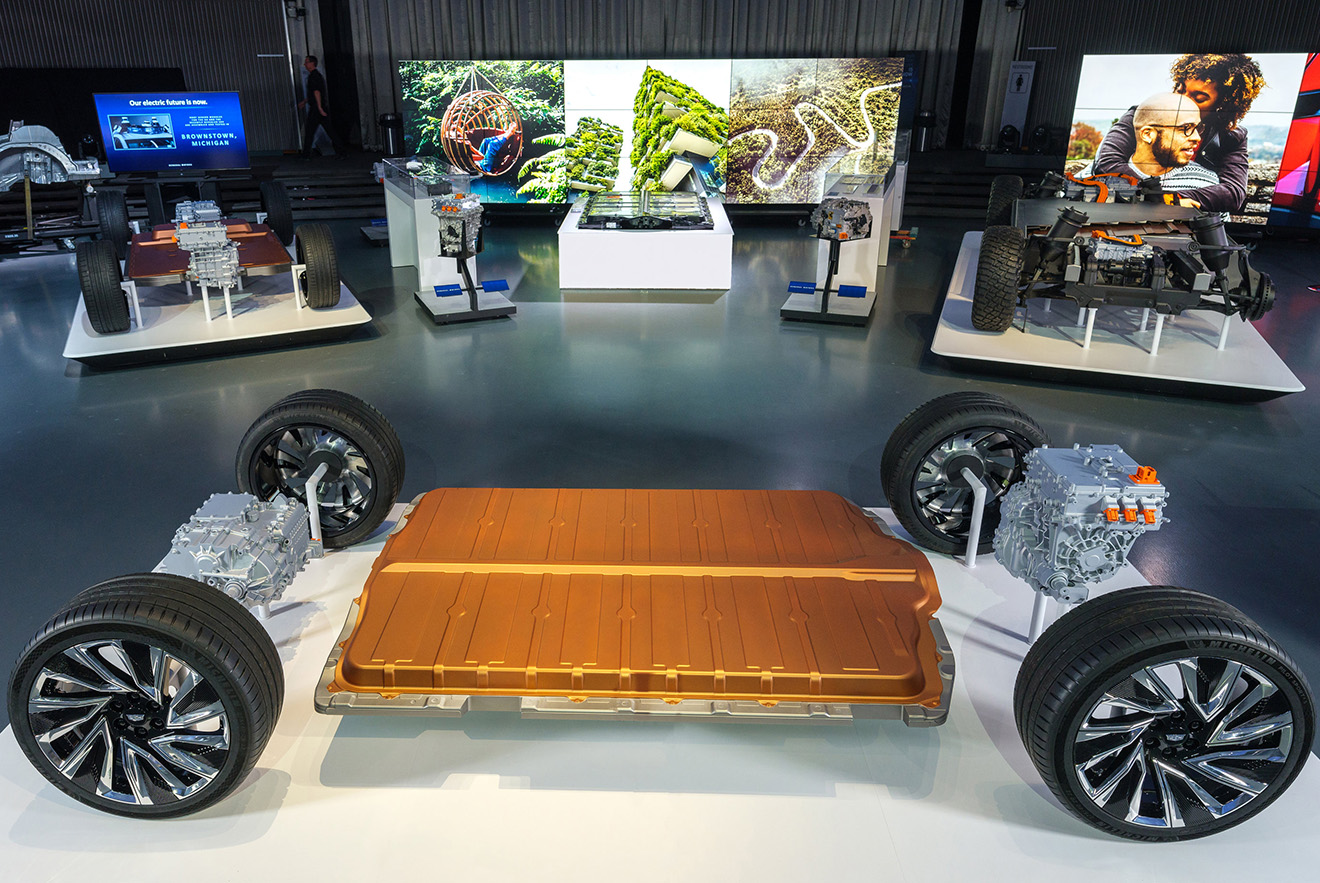
Think of an EV battery as the fuel tank and engine combined.
As an electric vehicle ages, its battery gradually loses a small amount of its original energy capacity—a natural process called battery degradation. This happens in all lithium-ion batteries over time.
What Does Battery Health Affect?
Driving Range: How far you can drive on a single full charge.
Charging Efficiency: How quickly the battery accepts rapid DC fast charging.
Vehicle Value & Resale: A healthy battery preserves long-term resale value.
Warranty Coverage: Remaining years/miles of factory high-voltage protection.
The Good News About Degradation
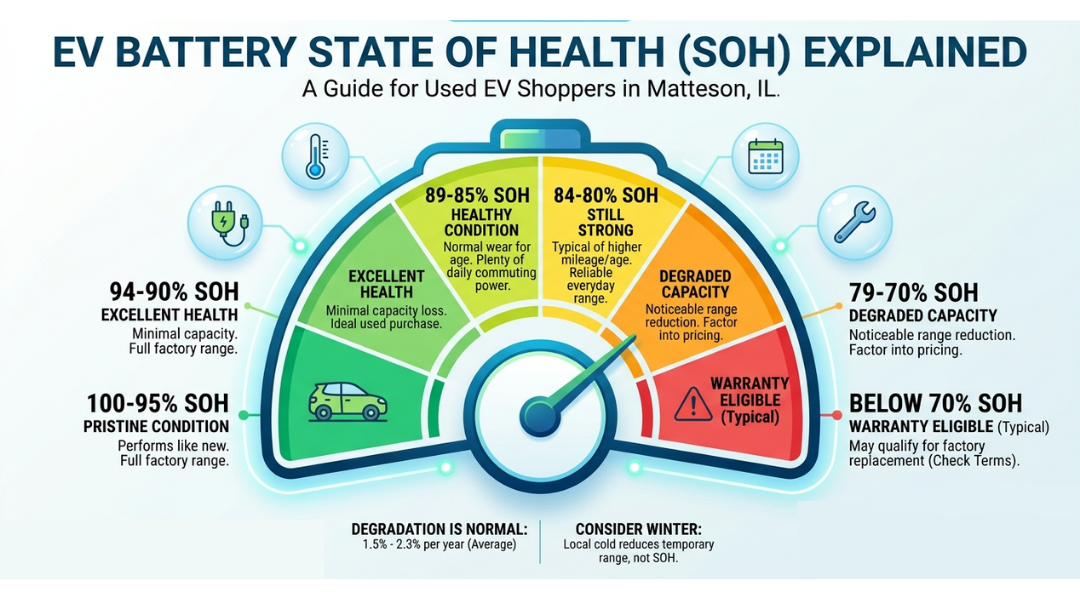
Modern EV batteries age remarkably well. Real-world fleet telematics show that most modern EV batteries degrade at an average rate of 1.5% to 2.3% per year under normal driving conditions. That means a 4-to-5-year-old used EV often retains over 90% of its original battery capacity.
What Is Battery State of Health (SOH)?
The single most critical diagnostic metric when shopping for a used EV is State of Health (SOH).
State of Health is expressed as a percentage that compares the battery’s current max usable capacity to its original factory capacity when brand new.
State of Health (SOH)
What It Means for You
100% SOH
Performs exactly like a brand-new factory battery.
90%–95% SOH
Minimal, normal capacity loss; excellent condition for a pre-owned EV.
80%–89% SOH
Typical for older or higher-mileage EVs; still offers plenty of daily commuting power.
Below 80% SOH
Noticeable range reduction; may qualify for factory warranty replacement if coverage is active.
Mileage vs. Battery Health: Unlike gasoline engines where lower mileage is almost always better, an EV’s battery health depends heavily on age, charging habits, climate, and thermal management. A higher-mileage EV that was gently slow-charged can actually have a healthier battery than a lower-mileage EV that spent its life on rapid fast chargers in hot climates.
5 Essential Steps to Evaluate a Used EV Battery
1. Request an Official Battery Health Diagnostic
Never guess when you can measure. Ask the seller or dealership for a comprehensive diagnostic scan.
Franchised dealerships use factory diagnostic tools to pull direct battery management system (BMS) data. For multi-brand inventory or private sales, independent third-party reports (such as Recurrent Battery Reports) or an OBD-II scanner can provide an accurate SOH score and battery status.
2. Don’t Rely Solely on the “Dashboard Range Estimate”
One of the most common mistakes buyers make is looking at the range display on the instrument cluster (often nicknamed the “Guess-O-Meter”) and assuming it reflects overall battery health.
The range estimate changes constantly based on:
Outside ambient temperature
Recent driving aggressive vs. gentle speed
Heating, ventilation, and air conditioning (HVAC) usage
Recent highway vs. city mileage history
A low dashboard estimate often just means the previous test driver had the heater blasting or drove aggressively on the highway—it does not mean the battery itself is degraded.
3. Factor in Illinois Winters (Temporary Range Drop vs. Degradation)
For drivers in Matteson and the South Suburbs, winter performance is top of mind.
Cold freezing weather temporarily slows down the chemical reactions inside a lithium-ion battery, which can temporarily reduce your driving range by 20% to 30% during winter months.
Important Distinction: Cold-weather range drop is temporary. When spring temperatures return, your full range returns. Temporary winter range loss is entirely separate from permanent battery degradation.
4. Verify Active High-Voltage Warranty Coverage
Under U.S. federal law, all electric vehicles sold in the United States carry a dedicated high-voltage battery warranty covering a minimum of 8 years or 100,000 miles (California and certain ZEV-state vehicles extend up to 10 years or 150,000 miles).
Warranties Follow the VIN: Factory high-voltage battery warranties automatically transfer to second and third owners—they stay with the vehicle, not the original buyer.
Degradation Thresholds: Most manufacturer warranties guarantee replacement if the battery’s State of Health drops below 70% within the warranty period.
5. Check Vehicle History, Recalls, and Software Updates
Ask for a Vehicle History Report (CARFAX® or AutoCheck®) and confirm:
Recall Status: Ensure all manufacturer battery software updates and safety recalls have been completed.
Thermal Management: Modern EVs equipped with liquid-cooled battery packs handle hot summers and cold Midwest winters far better than older air-cooled designs.
Shop Certified Quality Used EVs at Arnie Bauer Buick GMC
If you’re searching for a reliable pre-owned electric vehicle in Matteson, Tinley Park, Frankfort, Olympia Fields, Homewood, or Richton Park, our team at Arnie Bauer Buick GMC is here to guide you every step of the way.
We evaluate our used EV inventory to ensure you receive verified battery condition details, clear warranty terms, and transparent vehicle histories so you can drive home with complete peace of mind.
How do I check the State of Health (SOH) on a used EV?
The most reliable method is through a factory dealership diagnostic tool or a third-party EV battery report (such as Recurrent). These tools read the battery management system (BMS) directly rather than relying on estimated dashboard range numbers.
Is battery degradation in a used EV normal?
Yes. All lithium-ion batteries experience slow, normal capacity loss over time. Modern EVs average only 1.5% to 2.3% capacity loss per year, meaning a pre-owned EV typically retains the vast majority of its original driving capability.
Does the factory battery warranty transfer when I buy a used EV?
Yes! Federal law requires manufacturers to provide high-voltage EV battery coverage for at least 8 years or 100,000 miles. This warranty attaches to the vehicle’s VIN number and automatically transfers to subsequent owners as long as time and mileage limits remain active.
How much driving range will an EV lose in Chicago-area winters?
In cold Midwest winter conditions, electric vehicles can temporarily experience a 20% to 30% drop in single-charge range due to HVAC heating demand and battery temperature. However, this effect is purely temporary and does not permanently damage or degrade the battery.