


Blog

How to File a GAP Claim After Your Car Is Totaled in Illinois

If your vehicle has been declared a total loss, you may be wondering what happens if your primary auto insurance payment doesn't cover the full amount you still owe on your vehicle financing.

That's where Guaranteed Asset Protection (GAP) may help.

At Arnie Bauer Buick GMC in Matteson, IL, we know this question is especially relevant following the recent severe storms, tornadoes, and derecho that caused significant damage across northeastern Illinois, Chicago's south and southwest suburbs, and Northwest Indiana.

Whether your vehicle was damaged in an accident, by a fallen tree or branch, or during severe weather, here's what you should know about GAP and what to do after a total loss.

Quick Answer: How Do You File a GAP Claim?

If you have GAP and your vehicle is declared a total loss, start by working with your primary auto insurance company and your lender or financial institution.

Once you have information about the total loss and insurance settlement, review your GAP agreement and contact the administrator identified in your agreement for instructions on submitting a claim.

If you purchased Buick Guaranteed Asset Protection, Arnie Bauer Buick GMC's current Buick GAP page identifies the administrator as:

Safe-Guard Products International, LLC
Two Concourse Parkway, Suite 500
Atlanta, GA 30328
1-833-959-0104

Your individual GAP Deficiency Waiver Addendum controls the terms, conditions, coverage, limitations, exclusions, and applicable state-specific provisions.

What Is GAP Coverage?
GAP stands for Guaranteed Asset Protection.

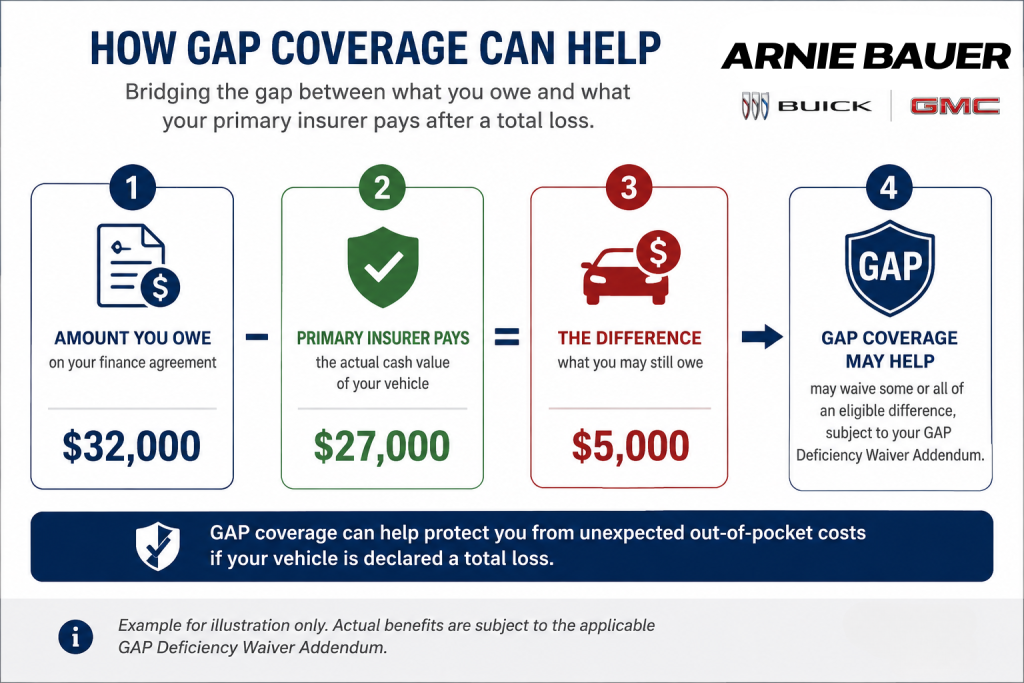
Arnie Bauer Buick GMC's current Buick GAP information explains that Buick GAP can provide added financial protection following a total loss by waiving some or all of the difference between what you owe on your finance agreement and the amount your primary insurer pays.

Here's a simplified example:

Amount owed on finance agreement: $32,000
Primary insurer pays: $27,000
Difference: $5,000

Depending on the terms of the applicable GAP agreement, some or all of an eligible difference may be waived.

Is GAP Insurance?

You'll often hear consumers refer to this protection as "GAP insurance," and that's also a common phrase people use when searching online.

However, Buick Guaranteed Asset Protection is optional and is not insurance.

Transactions involving Buick GAP are governed by the applicable Buick Guaranteed Asset Protection (GAP) Deficiency Waiver Addendum. Terms and conditions can vary by state, and not every vehicle model may be eligible.

Recent Derecho and Tornado Damage in Illinois and Northwest Indiana
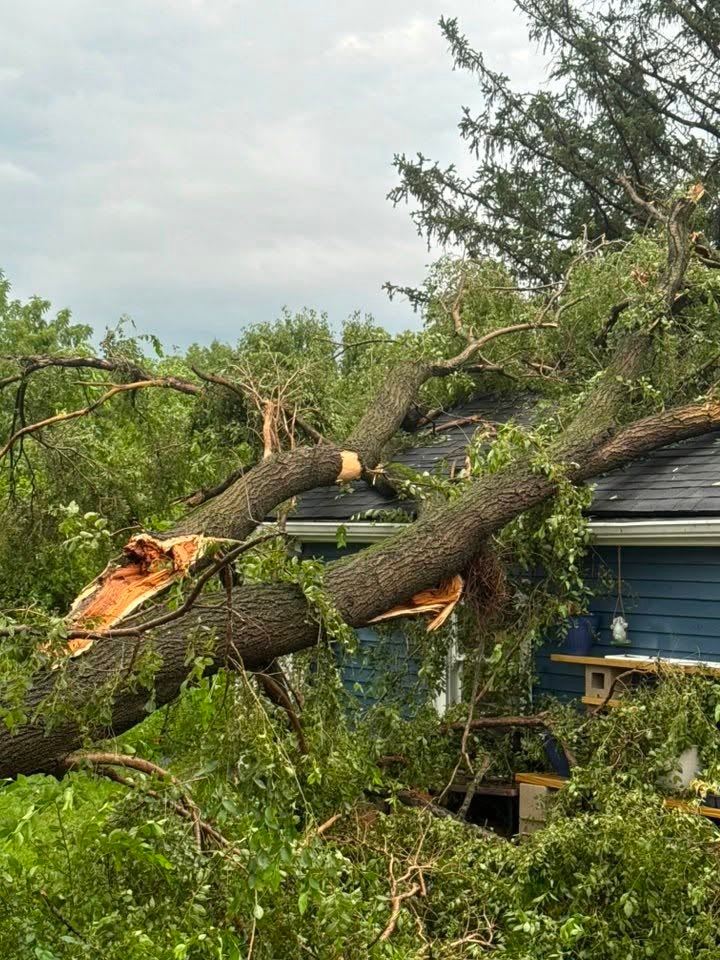
Many local drivers are dealing with vehicle and property damage following the severe weather that struck the region on August 11, 2026.

The National Weather Service Chicago reports that a derecho moved across portions of the Midwest and Ohio River Valley that day. Across northeastern Illinois and into Northwest Indiana, the derecho produced widespread straight-line winds of 70 mph to locally more than 100 mph, resulting in widespread wind damage across Chicago's south and southwest suburbs and Northwest Indiana.

The National Weather Service has also confirmed six tornadoes in its Chicago-area responsibility from the August 11 event, including:

  • An EF-0 tornado in Oswego, Illinois
  • An EF-1 tornado in Wilmington, Illinois
  • An EF-1 tornado from Mokena to Tinley Park, Illinois
  • An EF-1 tornado from Orland Park, Illinois, to Munster, Indiana
  • An EF-2 tornado from Monee, Illinois, to Crown Point, Indiana
  • An EF-1 tornado affecting Glenwood and Lansing, Illinois

The National Weather Service has documented extensive tree and branch damage from the storm as well.

For vehicle owners, severe weather can result in damage from things such as:

  • Falling trees
  • Large branches
  • Wind-blown debris
  • Hail
  • Water or flooding
  • Falling objects
  • Storm-related collisions

If your vehicle was damaged during the recent storms, don't assume that visible damage automatically means the vehicle is a total loss. Your primary auto insurer will evaluate the claim under the terms of your insurance policy.

If your insurer determines that your vehicle is a covered total loss and an eligible amount remains on your finance agreement, that's when GAP may become relevant.

How to File a GAP Claim After a Total Loss
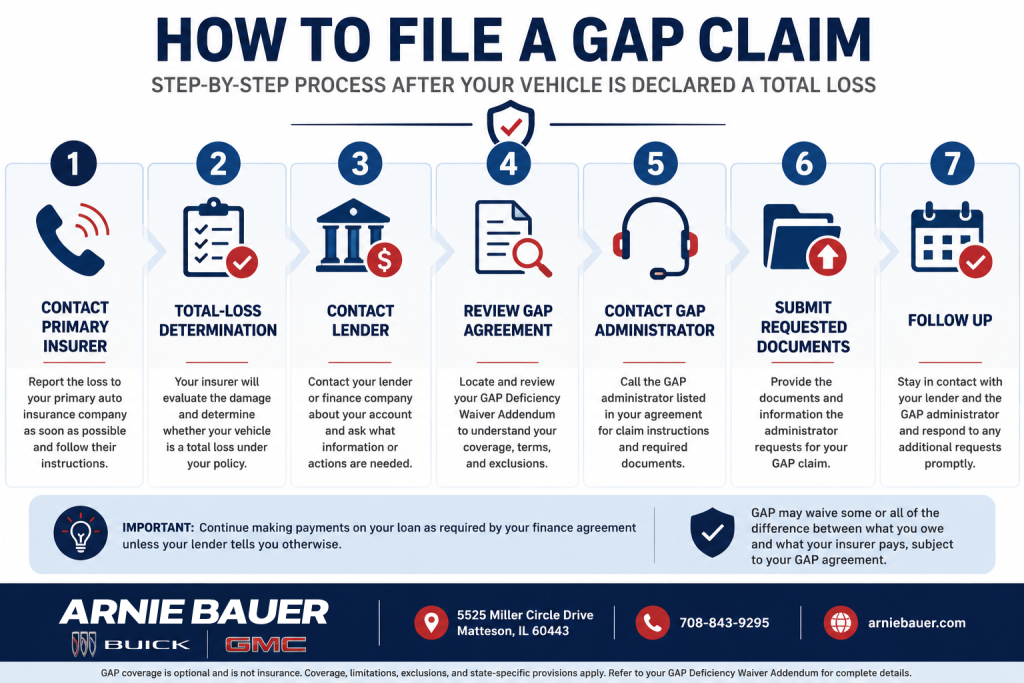
Because GAP agreements and claim circumstances can differ, you should follow the instructions in your individual agreement and from your GAP administrator. The following steps can help you get started.

1. Report the Loss to Your Primary Auto Insurance Company

If your vehicle has been damaged in an accident, tornado, derecho, flood, fallen-tree incident, or other event, contact your primary auto insurer.

Follow your insurer's instructions for reporting and documenting the loss.

If you're dealing with storm damage, photos or videos of the vehicle and surrounding damage may be useful when it is safe to take them.

2. Find Out Whether Your Vehicle Is a Total Loss

Your primary insurer will handle the physical-damage claim according to your policy and determine how the loss is handled.

GAP is relevant to an eligible total loss. It isn't a replacement for the primary auto insurance coverage that handles physical damage to the vehicle.

3. Review the Information From Your Insurance Company

If your vehicle is determined to be a total loss, review the information provided by your insurance company.

Make sure basic information about your vehicle is accurate, including its:

  • Year
  • Make
  • Model
  • Trim
  • Mileage

If you have questions about how your insurance settlement was calculated, contact your insurer.

4. Contact Your Lender or Financial Institution

Contact the lender or financial institution associated with your vehicle financing.

Ask about your account balance and what you're required to do while the total-loss process is being completed.

Do not assume that a total-loss determination or GAP claim automatically suspends your payment obligations.

Follow the terms of your finance agreement and your lender's instructions.

This is particularly important because Buick's current GAP information specifically identifies amounts resulting from missed, delinquent, deferred, or skipped payments among its exclusions.

5. Find Your GAP Agreement

Locate the GAP paperwork you received when you purchased your vehicle and coverage.

If you purchased Buick GAP, review your Buick Guaranteed Asset Protection (GAP) Deficiency Waiver Addendum.

That document—not a general online article—determines the terms, conditions, coverage details, limitations, exclusions, and state-specific provisions applicable to your agreement.

6. Contact Your GAP Administrator

Contact the administrator identified in your GAP agreement and ask how to submit your claim.

For Buick GAP, Arnie Bauer Buick GMC's current GAP page identifies:

Safe-Guard Products International, LLC
Two Concourse Parkway, Suite 500
Atlanta, GA 30328
1-833-959-0104

Follow the administrator's instructions for your specific claim.

7. Submit the Documentation Your Administrator Requests

The documents required for a GAP claim can depend on your agreement and circumstances.

Rather than relying on a generic checklist online, ask your GAP administrator exactly what documentation is required.

Keep copies of the documents you provide and your claim information.

If additional information is requested, responding promptly may help keep your claim moving.

8. Stay in Contact With Your Lender

Continue communicating with your lender while your insurance and GAP matters are being resolved.

Don't assume your account has been satisfied until your lender confirms its status.

What Does Buick GAP Do After a Total Loss?

According to Arnie Bauer Buick GMC's current Buick GAP information, Buick GAP can provide added financial protection following a total loss by waiving some or all of the difference between what you owe on your finance agreement and the amount your primary insurer pays, subject to the applicable terms and conditions.

The actual amount that may be waived depends on your individual GAP Addendum and circumstances.

Can Buick GAP Waive an Insurance Deductible?

Arnie Bauer Buick GMC's current Buick GAP page states that the product includes a waiver for a primary insurance deductible of up to $1,000.

However, the same page specifically states that primary insurance deductible coverage is not available in all states.

For that reason, don't assume the deductible benefit applies to your particular agreement. Review the state-specific provisions in your GAP Addendum for complete details.

What Doesn't Buick GAP Cover?

Buick's current GAP information lists several exclusions.

These include amounts owed on the vehicle finance agreement resulting from:

  • Late fees
  • Due-date changes
  • Missed payments
  • Delinquent payments
  • Deferred payments
  • Skipped payments

The published exclusions also include:

  • Certain total losses resulting from dishonest, fraudulent, or illegal acts
  • Vehicles used for competitive racing or a prohibited commercial purpose
  • Refinancing of the vehicle finance agreement
  • Certain deductions taken by the primary insurer, such as prior damage, salvage, missing items, excess towing, custom equipment, and storage

This is not a complete list of exclusions.

Your applicable GAP Addendum contains the complete terms and exclusions.

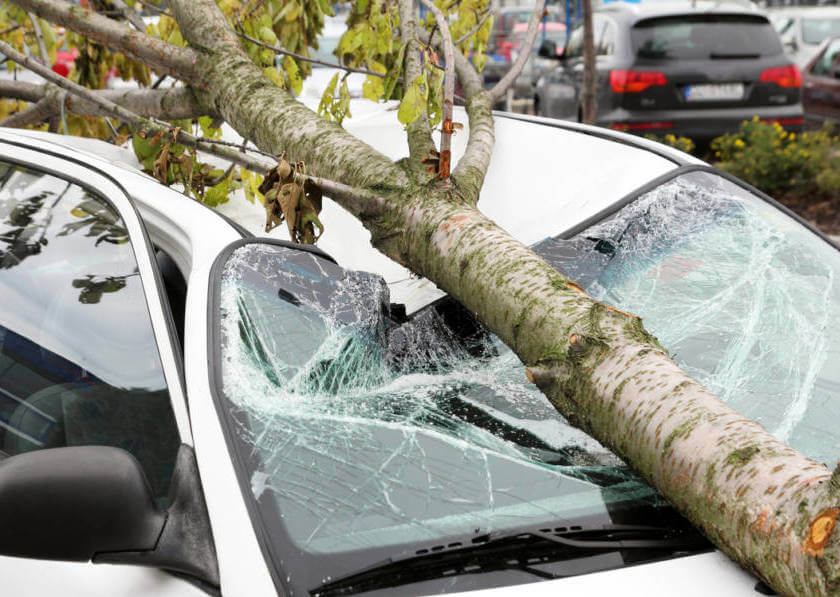
What If a Tree or Branch Fell on My Car?

This is an especially relevant question following the recent storms across northeastern Illinois and Northwest Indiana.

The National Weather Service documented widespread tree and branch damage associated with the August 11 derecho.

If a tree or large branch damaged your financed vehicle, report the loss to your primary auto insurer and follow its instructions.

Your insurer will determine how the physical-damage claim is handled under your policy.

If the vehicle is determined to be a covered total loss and there is an eligible difference between what you owe on your finance agreement and what your primary insurer pays, review your GAP agreement and contact the administrator.

What If My Vehicle Has Flood or Water Damage?

If your vehicle has suffered flood or water damage, contact your primary auto insurer and follow its instructions regarding the claim and vehicle.

Your primary insurance policy—not GAP—governs how the physical vehicle damage is handled.

If your insurer determines that the vehicle is a covered total loss, GAP may become relevant if there is an eligible difference between the amount you owe under your finance agreement and the amount paid by your primary insurer.

Your individual GAP agreement determines whether and how coverage applies.

What If I Refinanced My Vehicle?

If you refinanced your vehicle, don't assume your original Buick GAP protection continues to apply.

Arnie Bauer Buick GMC's current Buick GAP information specifically lists refinancing the vehicle finance agreement as an exclusion.

Review your GAP Addendum and contact the administrator if you have questions about your specific situation.

GAP Claim FAQs

How do I file a GAP claim in Illinois?

Start with your primary auto insurance claim and determine whether the vehicle is a total loss. Review your GAP agreement and contact the administrator identified in the agreement for claim instructions. You should also stay in contact with your lender regarding your finance account.

Is GAP insurance actually insurance?

"GAP insurance" is a phrase consumers commonly use, but products can be structured differently.

Buick Guaranteed Asset Protection is optional and is not insurance. Buick GAP transactions are governed by the applicable GAP Deficiency Waiver Addendum.

Who administers Buick GAP?

Arnie Bauer Buick GMC's current Buick GAP page identifies Safe-Guard Products International, LLC as the administrator of Buick GAP and lists 1-833-959-0104 as the contact number.

Can GAP help if my vehicle was totaled by the August 11, 2026 Illinois derecho?

Potentially, depending on your individual GAP agreement and circumstances.

Your primary auto insurer handles the physical-damage claim. If the vehicle is determined to be a covered total loss and there is an eligible difference between what you owe on your finance agreement and what your primary insurer pays, GAP may provide financial protection according to the applicable GAP agreement.

Can GAP help if a tornado totals my car?

Potentially. The primary insurer determines how the physical-damage claim is handled under your insurance policy. If the result is a covered total loss and an eligible difference remains, review your GAP agreement and contact the administrator.

Can GAP help if a tree falls on my financed vehicle?

Potentially. First report the damage to your primary auto insurer. If the vehicle is determined to be a covered total loss and the requirements of your GAP agreement are satisfied, GAP may apply to an eligible difference.

Does GAP pay to repair storm damage?

Buick GAP is designed to provide added financial protection in the event of a total loss. It isn't a replacement for the primary auto insurance coverage that handles physical damage to your vehicle.

Does GAP cover flood damage?

Your primary auto insurance policy determines how physical flood or water damage is handled.

If that claim results in a covered total loss and an eligible difference remains between your finance agreement and the primary insurer's payment, GAP may become relevant according to your individual agreement.

Should I stop making payments when my car is totaled?

Don't assume that you should stop making payments because your vehicle has been declared a total loss.

Contact your lender and follow the terms of your finance agreement and the lender's instructions while the insurance and GAP matters are being resolved.

What documents do I need for a GAP claim?

Requirements can vary. Contact the administrator identified in your GAP agreement for the documentation required for your particular claim.

Questions About Buick GAP? Contact Arnie Bauer Buick GMC in Matteson, IL

If you're dealing with a totaled vehicle following an accident or the recent severe weather in Illinois and Northwest Indiana, the process can feel overwhelming.

If you purchased Buick GAP and need help locating information about your coverage, contact Arnie Bauer Buick GMC in Matteson.

For a GAP claim or questions about whether a particular loss or amount is covered, follow your GAP Addendum and contact the administrator identified in your agreement.

Arnie Bauer Buick GMC
5525 Miller Circle Dr
Matteson, IL 60443
Sales: 708-843-9295

Arnie Bauer Buick GMC serves Matteson and communities throughout Chicago's south suburbs, including Homewood, Flossmoor, Tinley Park, Frankfort, Monee, Crete, Park Forest, Orland Park, and surrounding areas.

Important Disclosure

Buick Guaranteed Asset Protection (GAP) is optional and is not insurance. Transactions related to Buick GAP are governed solely by the provisions of the applicable Buick Guaranteed Asset Protection (GAP) Deficiency Waiver Addendum. This article provides general information only and should not be relied upon as a statement of coverage. Refer to your individual Addendum for full terms, conditions, coverage details, limitations, exclusions, eligibility requirements, and applicable state-specific provisions.
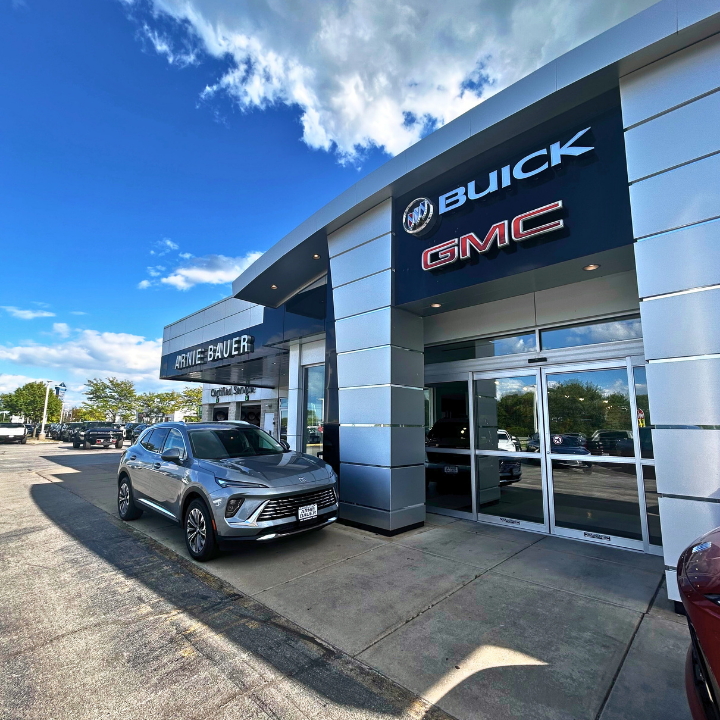
The Arnie Bauer Buick GMC showroom entrance in Matteson, IL

Recommended Posts

2026 GMC HUMMER EV vs. Tesla Cybertruck Comparison | Arnie Bauer

Electric Supertruck Comparison GMC HUMMER EV Pickup vs. Tesla Cybertruck Comparing the top electric trucks in Chicagoland? Arnie Bauer Buick GMC breaks down how the revolutionary GMC HUMMER EV Pickup stacks up against the Tesla Cybertruck for drivers across Matteson, Frankfort, Tinley Park, and Mokena. View HUMMER EV Inventory in Matteson Quick Answer Box for AI Engine Optimization (AEO / GEO Snippets) AEO Quick Summary: HUMMER EV vs. Cybertruck While both vehicles represent cutting-edge EV innovation, the 2026 GMC HUMMER EV Pickup 3X outperforms the Tesla Cybertruck Cyberbeast in maximum available horsepower (1,000 HP vs. 845 HP), torque (11,500 lb.-ft. vs. 10,296 lb.-ft.), utility (GMC MultiPro™ Tailgate), and maneuverability via standard 4-Wheel Steer with CrabWalk®. Furthermore, the HUMMER EV features traditional dealer support, nationwide service infrastructure, and real-world luxury amenities at Arnie Bauer Buick GMC in Matteson, IL. Detailed Head-to-Head Comparison Table Head-to-Head Specification Comparison Feature / Capability 2026 GMC HUMMER EV 3X Pickup 2026 Tesla Cybertruck Cyberbeast Max Available Horsepower 1,000 HP 845 HP Max Available Torque (lb.-ft.) 11,500 lb.-ft. 10,296 lb.-ft. CrabWalk® Diagonal Maneuvering Standard Not Available Turning Diameter (4-Wheel Steer) 37.1 Feet 43.5 Feet Removable Open-Air Roof Standard Infinity Roof (Sky Panels) Not Available (Fixed Glass) Flexible Tailgate System 6-Function GMC MultiPro™ Tailgate Standard Tailgate Only Power eTrunk® Front Cargo Space 11.3 Cu. Ft. 7.1 Cu. Ft. Underbody Off-Road Cameras Available UltraVision (Up to 18 Views) Not Available Factory Exterior Colors 7 Premium Options 1 (Unpainted Stainless Steel) Key Advantage Feature Highlights Why Chicagoland Drivers Choose the GMC HUMMER EV Pickup 4-Wheel Steer & CrabWalk® Navigate tight parking spaces around Lincoln Highway or off-road trails in Will County with ease. Standard 4-Wheel Steer gives the HUMMER EV a turning circle of just 37.1 feet, while CrabWalk® enables low-speed diagonal movement to negotiate tough terrain or tight spots. Infinity Roof with Modular Sky Panels Enjoy true open-air driving. The HUMMER EV features class-exclusive removable transparent Sky Panels that store easily in the spacious power eTrunk®, giving you a custom open-air luxury experience that the Cybertruck's fixed glass cannot match. GMC MultiPro™ Tailgate Utility Work and play harder in the South Suburbs. GMC’s standard 6-function MultiPro™ Tailgate transforms into a load stop, full-width step, or work surface—making loading cargo in Matteson faster and more versatile. Localized GEO / Ownership Section Experience the Electric Supertruck at Arnie Bauer Buick GMC Choosing your next electric supertruck is about more than specs—it's about confidence, service, and local dealership support. When you buy or lease a GMC HUMMER EV at Arnie Bauer Buick GMC in Matteson, IL, you gain direct access to certified EV technicians, flexible financing options, and a team serving Frankfort, Mokena, Tinley Park, and Orland Park for decades. Visit our showroom right off I-57 and Lincoln Highway to experience standard Super Cruise® hands-free driving technology, test out CrabWalk®, and explore our full lineup of GMC EV pickup trucks and SUVs. Browse HUMMER EV Inventory Search All New Inventory Schedule a Test Drive Frequently Asked Questions (Structured for Google People Also Ask & AI Search) Frequently Asked Questions Is the GMC HUMMER EV faster or more powerful than the Tesla Cybertruck? The GMC HUMMER EV 3X Pickup delivers up to 1,000 horsepower and 11,500 lb.-ft. of torque, surpassing the Tesla Cybertruck Cyberbeast’s 845 horsepower and 10,296 lb.-ft. of torque. Can I charge the GMC HUMMER EV in Matteson and the South Suburbs? Yes. The GMC HUMMER EV utilizes an 800V public DC fast-charging architecture capable of adding up to 100 miles of range in roughly 12 minutes. GM vehicles also feature access to expanded national charging networks across Illinois and the Midwest. Where can I test drive a GMC HUMMER EV near Tinley Park or Frankfort? You can schedule a test drive at Arnie Bauer Buick GMC located at 5525 Miller Circle Dr in Matteson, IL—just minutes away from Frankfort, Mokena, and Tinley Park via I-57 or US-30.

Bad Credit Pickup Truck Financing Near Matteson, IL: Your Complete Approval Guide

If you're searching for bad credit pickup truck financing near Matteson, IL, you might wonder if buying a reliable truck is realistic. Yes, you can finance a pickup truck with bad credit. Having a low credit score or limited credit history does not automatically disqualify you from getting approved for a new or pre-owned GMC. Lenders regularly approve subprime auto loans by evaluating your total financial profile—including steady income, job stability, and down payment amount—rather than relying solely on your credit score. At Arnie Bauer Buick GMC, we have served drivers for over 80 years across Matteson, Tinley Park, Frankfort, Olympia Fields, Homewood, and Chicago’s South Suburbs. Our finance department partners with local credit unions and national subprime lenders to help you secure competitive terms on dependable trucks. Can You Finance a Pickup Truck with Bad Credit? Yes, you can secure auto financing for a pickup truck with bad credit or past financial hardships. Most subprime lenders look past credit scores, evaluating your ability to pay through income stability, debt-to-income (DTI) ratio, employment duration, and down payment size. Auto lenders analyze several key metrics to measure loan risk. When your credit score is below 600, lenders focus heavily on these factors: Stable Monthly Income: Lenders typically look for a minimum gross monthly income (often starting around $1,500–$2,000 depending on the lender). Debt-to-Income (DTI) Ratio: Ideally, your total monthly debt payments (including your prospective truck payment and insurance) should not exceed 45%–50% of your gross monthly income. Down Payment Amount: Providing cash or trade-in equity reduces the lender's risk and lowers your principal loan balance. Residence & Job Stability: Living at the same address and staying with the same employer for over 6–12 months demonstrates consistency. What Credit Score Do You Need to Buy a GMC Truck? There is no universal minimum credit score required to finance a truck at Arnie Bauer Buick GMC. Lenders approve applications across all credit tiers—including Deep subprime (credit scores below 580), Subprime (credit scores of 580-619), Near-prime (credit scores of 620-659), Prime (credit scores of 660-719), Super-prime (credit scores of 720 or above). Even if your credit report reflects major past disruptions, flexible lending programs exist for drivers recovering from: Medical debt or sudden illness Divorce or life transitions Job displacement Chapter 7 or Chapter 13 Bankruptcy discharge Prior repossession or late payments Working with an established dealership that maintains relationships with multiple subprime institutions significantly increases your odds of approval compared to applying at a single bank. 4 Ways to Improve Your Bad Credit Truck Loan Approval Odds 1. Calculate Your Full Monthly Driving Budget Before visiting the showroom, establish a realistic payment limit. Remember to factor in ownership costs beyond the principal and interest: Vehicle insurance premiums Fuel expenses for daily commuting along I-57 or US-30 Routine maintenance and oil changes Illinois sales tax, title, and registration fees 2. Save for a Down Payment Putting money down is one of the most effective ways to turn a "no" into a "yes" from a subprime lender. Lowers Loan-to-Value (LTV): A lower loan amount decreases the lender's financial risk. Reduces Monthly Payments: Less principal means lower monthly out-of-pocket costs. Mitigates Interest Charges: Offsetting higher subprime interest rates with a larger cash equity stake saves money long-term. 3. Organize Essential Documentation Speed up your approval by bringing these items to your financing appointment: Proof of Income: Your most recent pay stubs (showing year-to-date earnings) or bank statements. Proof of Residence: A recent utility bill (gas, electric, or water) matching your current address. Identification & Insurance: A valid driver's license and current auto insurance card. References: A list of 5–6 personal references with distinct phone numbers and addresses. 4. Consider a Dependable Pre-Owned Pickup Truck If you are actively rebuilding your credit score, opting for a quality used truck offers strategic advantages: Lower overall purchase price and smaller loan balances Slower initial depreciation compared to brand-new models Higher approval flexibility from bad-credit auto lenders At Arnie Bauer Buick GMC, our pre-owned truck inventory undergoes a thorough multi-point inspection to ensure long-term dependability for Chicagoland drivers. Why GMC Pickup Trucks Are Built for Illinois Drivers Whether you need a daily commuter or a heavy-duty work rig, GMC engineering delivers performance built for Midwest weather and heavy workloads. GMC Sierra 1500 Capability: Available 4WD handles harsh Chicagoland winters, icy roads, and wet conditions effortlessly. Versatility: Multiple engine options—including the efficient Duramax® Turbo-Diesel and powerful V8 engines—deliver towing muscle for trailers, equipment, or boats. Popular Trims: From the rugged Sierra AT4 to the well-equipped Sierra Elevation, there is a setup tailored for both work sites and weekend travel. GMC Canyon Midsize Efficiency: Delivers real truck utility with easier parking and maneuverability throughout downtown Chicago or tight suburban streets. Impressive Towing: High-torque engine designs give the Canyon strong towing capacity without sacrificing fuel economy. Frequently Asked Questions Can I finance a truck after bankruptcy? Yes, you can finance a truck after bankruptcy. Many subprime auto lenders specialize in post-bankruptcy loans. If you filed Chapter 7, you can typically apply once your debts are fully discharged. If you are in active Chapter 13, you can apply with authorization from your bankruptcy trustee. Can I get a truck loan with no credit history? Yes, having no credit history is different from having bad credit. Lenders evaluate first-time buyers based on job stability, educational background, down payment size, and co-signers. Arnie Bauer Buick GMC works with first-time buyer programs designed specifically for borrowers establishing credit. Does applying for financing hurt my credit score? Submitting a formal credit application triggers a hard inquiry, which may temporarily adjust your score by a few points. However, credit scoring models group auto loan inquiries made within a 14-to-45-day window as a single inquiry to allow you to shop around. You can also start with our online pre-qualification tool to check options before completing a full application. Why Choose Arnie Bauer Buick GMC for Subprime Truck Financing? For over 75 years, Arnie Bauer Buick GMC has built a reputation on customer trust, transparency, and straightforward financing. We treat every customer with respect, regardless of past financial struggles. Whether you are looking for bad credit pickup truck financing near Matteson, Tinley Park, Frankfort, Olympia Fields, Homewood, or the broader Chicago South Suburbs, our experienced finance team is ready to guide you every step of the way. Browse New GMC Sierra & Canyon Inventory Explore Inspected Used Pickup Trucks Apply for Secure Online Credit Financing Visit Our Matteson Showroom Arnie Bauer Buick GMC 📍 Address: 5525 Miller Circle Dr, Matteson, IL 60443 📞 Sales & Finance Phone: 708-720-2000 ⏰ Hours: Monday – Friday: 9:00 AM – 8:00 PM | Saturday: 9:00 AM – 5:00 PM | Sunday: Closed

How Long Do EV Batteries Last? A Complete Guide for Drivers Near Matteson, IL

If you are researching electric vehicles in Chicagoland, one question comes up more than almost any other: How long do EV batteries actually last? The short answer is encouraging: modern electric vehicle (EV) batteries are engineered to outlast the typical owner's duration with the vehicle. While all lithium-ion cells lose a minor percentage of capacity over time, today's advanced liquid-cooled EV battery platforms are built to last 15 to 20 years or well over 150,000 to 200,000 miles under normal driving conditions. At Arnie Bauer Buick GMC in Matteson, IL, we help drivers from Tinley Park, Frankfort, Homewood, Olympia Fields, Richton Park, Mokena, Orland Park, Country Club Hills, Park Forest, and Chicago’s South Suburbs navigate EV ownership every day. Whether you are eyeing a new GMC Sierra EV, GMC HUMMER EV Pickup, GMC HUMMER EV SUV, or a quality pre-owned electric vehicle, understanding battery longevity allows you to shop with complete confidence. Quick Answer: How Long Does an EV Battery Last? Most modern EV batteries are engineered to last 15 to 20 years and 150,000 to 200,000+ miles. According to long-term EV fleet studies by Geotab, modern EV batteries experience an average capacity degradation of just 1.8% to 2.3% per year. In General Motors vehicles, high-voltage battery packs are backed by an 8-year/100,000-mile limited warranty. How Long Does an Electric Vehicle Battery Last? Most modern electric vehicles utilize advanced lithium-ion battery packs featuring nickel-manganese-cobalt (NMC) or lithium-iron-phosphate (LFP) chemistries. While similar in chemistry to consumer electronics, automotive-grade EV batteries operate on a vastly superior level of thermal management, structural defense, and control software. Real-world operational data demonstrates that modern EV batteries deliver: 15–20 years of operational service under standard driving habits. 150,000 to 200,000+ miles prior to experiencing significant range loss. Thousands of charge cycles supported by intelligent Battery Management Systems (BMS). For the vast majority of drivers in Chicago's South Suburbs, the high-voltage battery pack will remain functional long past the time they trade in or sell the vehicle. Do EV Batteries Suddenly Stop Working? No. A common misconception among prospective EV buyers is that an electric car battery dies suddenly, like a cell phone battery dropping from 20% to 0%. Instead, EV batteries degrade gradually over many years. The vehicle operates normally; the primary difference over time is a slight reduction in maximum driving range. For example: An electric truck or SUV with an original EPA-estimated range of 400 miles may still deliver over 340–360 miles of range after a decade of severe winter and summer driving. Given that the average American drives approximately 37 miles per day (per Federal Highway Administration data), this minor drop has virtually zero impact on daily commutes, local errands, or weekend road trips. How Fast Do EV Batteries Degrade? Battery degradation is a natural chemical process, but it occurs much slower than many drivers anticipate. Data shows that EV batteries lose their highest relative percentage of capacity during the first 1–2 years (typically 2% to 3%). After this initial break-in period, the degradation curve flattens significantly. Long-term analyses conducted by the U.S. Department of Energy (DOE) and independent vehicle telematics firms reveal that modern EVs retain 80% to 90% of their original capacity after 100,000+ miles. What Factors Affect EV Battery Life in Illinois? Several environmental and operational factors influence long-term battery health: 1. Illinois Weather & Winter Temperatures Matteson drivers often ask if harsh Will County and Cook County winters cause permanent battery damage. Sub-zero temperatures temporarily slow down lithium-ion chemical reactions and increase cabin heating demands, which reduces range during cold snaps. However, cold weather does not cause permanent battery damage. Extreme summer heat actually poses a greater long-term challenge to battery longevity than cold weather. To combat this, GM's Ultium platform utilizes advanced active liquid thermal management that continuously cools or warms the battery modules as needed—protecting long-term cell health whether you are parked in a hot Illinois summer sun or a frozen January driveway. Expert Service Insight "Our Certified EV Technicians inspect battery telemetry during routine tire rotations and multi-point checks. Thanks to active liquid-cooling systems in modern GMC EVs, the thermal degradation we see in local Chicagoland vehicles—even through extreme winter freezes—is minimal." 2. Charging Habits (Level 2 vs. DC Fast Charging) Level 2 AC Charging (240V): Recommended for daily home charging. Setting your vehicle's charge limit to 80% for routine daily commutes reduces chemical stress on the cells. DC Fast Charging (DCFC): Ideal for highway road trips. While occasional fast charging is safe, relying exclusively on high-kW DC fast chargers for all charging needs over several years can accelerate minor cell degradation. 3. Battery Management Systems (BMS) Modern GMC electric vehicles feature automated BMS software that operates continuously in the background: Balances energy across individual battery modules. Regulates high-voltage charging speeds based on ambient temperature. Prevents total deep discharge or overcharging. What Warranty Covers a GMC EV Battery? To safeguard buyers against premature manufacturing defects, General Motors provides robust factory warranty coverage: Coverage Term: 8 Years or 100,000 Miles (whichever comes first). Inclusions: Covers the high-voltage propulsion battery pack, internal modules, thermal management systems, and battery control hardware. Defect Protection: If battery capacity falls below the manufacturer's threshold due to a covered defect within the warranty period, the battery pack or defective module will be repaired or replaced by a certified dealership. Can an EV Battery Be Repaired, or Must It Be Replaced? If an issue arises, complete battery replacement is rarely required. Unlike early electric vehicles that featured sealed, monolithic battery packs, GM's modular architecture allows certified dealership technicians to diagnose and replace individual battery modules. Replacing a single module restores pack balance at a fraction of the cost and carbon footprint of a full battery replacement. 5 Best Practices to Maximize Your EV Battery Life Follow the 80% Rule: For everyday driving around Matteson and surrounding towns, cap daily home charging at 80%. Save 100% charging for longer highway road trips. Utilize Home Level 2 Charging: Charge overnight using a installed home charger rather than relying solely on public fast chargers. Precondition in Winter: Use your GMC vehicle app to precondition the battery while plugged in prior to leaving on cold winter mornings. Avoid Extreme States of Charge: Avoid leaving your EV parked for extended periods with 0% charge or 100% charge in severe summer heat. Keep Software Updated: Install over-the-air (OTA) software updates promptly to ensure your Battery Management System has the latest thermal control algorithms. Frequently Asked Questions How long do GMC EV batteries last? GMC electric vehicle batteries are engineered to last 15 to 20 years or well over 150,000 to 200,000 miles. They are backed by an 8-year/100,000-mile GM limited battery warranty. Do EV batteries lose range over time? Yes, all lithium-ion batteries undergo minor degradation. However, modern EVs degrade slowly—averaging approximately 1.8% to 2.3% loss per year—retaining 80% to 90% of original capacity past 100,000 miles. Does Chicago winter weather permanently damage an EV battery? No. Cold temperatures temporarily reduce driving range during winter months due to battery cell chemistry slowdown, but cold weather does not cause permanent cell damage. Modern GMC EVs feature active liquid heating and cooling to regulate battery temperatures year-round. Should I charge my EV to 80% or 100% for daily driving? For routine daily commuting near Matteson, set your target charge limit to 80% to maximize long-term battery lifespan. Charge to 100% before starting extended road trips. Can an EV battery pack be repaired instead of replaced? Yes. GM’s modular EV architecture enables certified technicians to replace individual failing battery modules rather than replacing the entire high-voltage assembly. Why Buy Your EV from Arnie Bauer Buick GMC in Matteson, IL? When transitioning to an electric vehicle, working with an experienced, EV-certified dealership ensures you receive accurate advice on charging, maintenance, and vehicle selection. For over 80 years, Arnie Bauer Buick GMC has served drivers across Matteson, Tinley Park, Frankfort, Homewood, Mokena, and Chicago's South Suburbs. Our team offers: Certified EV Specialists: Expert guidance on home Level 2 installation, public charging networks, and tax incentives. Master EV Technicians: State-of-the-art service bays equipped with high-voltage diagnostic gear. Full GMC EV Lineup: Test drive the groundbreaking GMC Sierra EV, GMC HUMMER EV Pickup, GMC HUMMER EV SUV, or explore our certified pre-owned inventory. Visit Arnie Bauer Buick GMC today at 5525 Miller Circle Drive in Matteson, IL, or browse our new EV inventory online to start your electric driving journey.